Campus ActivitiesAdayana Validate Program at DLIELC(CLICK HERE FOR STORY) DLIELC Newsletter(CLICK HERE FOR STORY)
DLIELC Around the Globe
U.S. Air Force Mentors Bring Power of AirLift to Afghans (news Article: by US Air Forces Central) |
News & Events
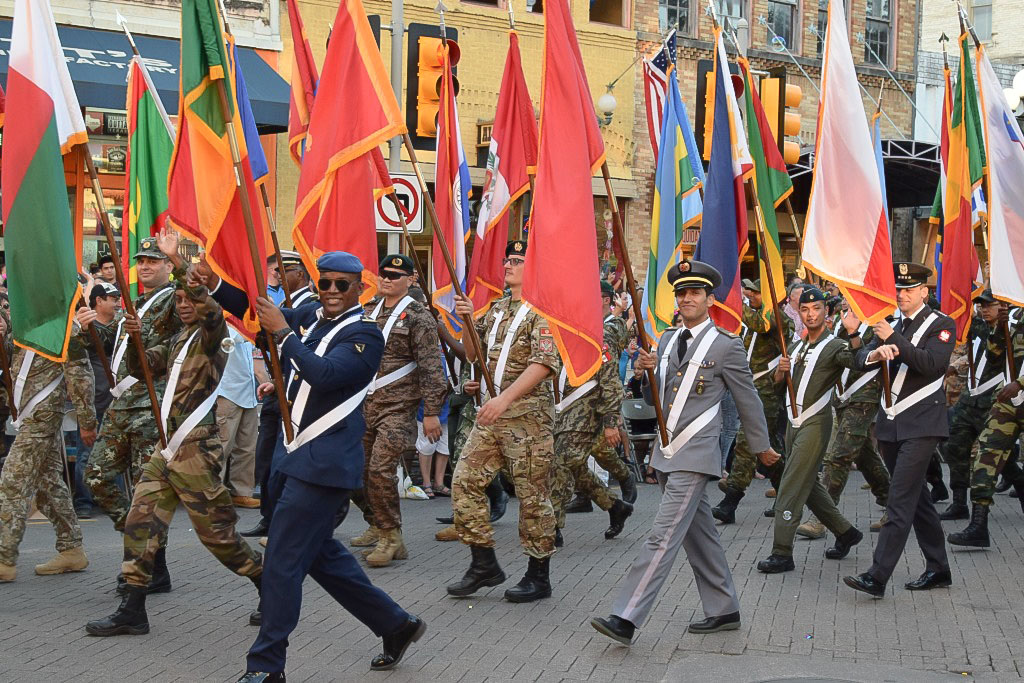
DLIELC's Entry into San Antonio's 2013 Festival Flambeau Parade
DLI provided a colorful foreign national flags and military uniforms formation for the San Antonio, Texas 2013 Fiesta Flambeau Parade. This is the 2nd year Milissa Stewart, Week-end Program Manager, Field Studies Program (FSP) Division, organized the participation of 88 DLI staff and international students (with flags from 52 countries represented as part of the parade Vanguard) in the 2.6 mile Fiesta night parade.
In plane English: teaching and writing aviation English for international military aircrews
by Sarah B. Hodge Defense LanguageInstitute English Language Center 1/24/14 - JOINT BASE SAN ANTONIO-LACKLAND, TEXAS -- The roar of two F-16 Fighting Falcons in full afterburner rattles windows as we discuss the day's low-level mission and do one last check on fuel calculations. A rainbow of squadron patches, flight suits and accents fills the room as pilots check radios and dial in altimeter settings, request taxi then take-off clearance, and one by one, take to the clear-blue skies over San Antonio via Microsoft Flight Simulator X. In the adjoining room, a group of classmates and aviation instructors play the role of the various air traffic control facilities. This mission provides the capstone to six weeks of aviation English academics, from aerodynamics in week one to flight planning using the Air Force Form 70 and DD-175 in weeks five and six. As an English for specific purposes curriculum developer at DLI-ELC, JBSA-Lackland, my goal is to get our international military pilots and aircrew proficient in aviation English and to familiarize them with the associated flying tasks and duties they will encounter at follow-on training bases around the United States. The Institute's six-week Aviate, Navigate, Communicate curriculum is built around a variety of authentic materials, including dash ones/dash tens, aeronautical charts, military air traffic control recordings, Air Force and Army training videos, aviation safety publications, computer-based training such as the commercial radio simulator COMM1 instrument flight rules and COMM1 visual flight rules trainers and having students plan and fly low-level missions in Flight Simulator X in the aviation lab. Students are instructed by a combination of English as a second language/English as a foreign language specialists and aviation subject matter experts. In 2012, more than 330 international military students completed the Aviate, Navigate, Communicate Course. The Institute's first two-week block of instruction, English Language Skills for Aviation, is designed to support a wide range of aviation backgrounds, limited not just to pilots and aircrew members but also to air traffic controllers, weapons controllers, weather forecasters and others. The class structure allows for a two-tiered approach to language learning via both group instruction and more individualized self-directed study. A single class may have a combination of experienced senior pilots with thousands of flying hours to fixed- and rotary-wing student pilots with zero flying hours, so DLI-ELC has spent several years developing a curriculum that meets the needs of the customer and is adaptable to a spectrum of aviation backgrounds and language levels. In this case, the customers are Air Force and Army flight training bases and posts. In support of our mission, I recently spent six months stationed with the Japan Air Self-Defense Force at Fifth Technical School, Komaki Air Base, Aichi, Japan. I taught nearly 200 Japanese F-15 Eagle and C-130 Hercules pilots, aircrew members, air traffic control and ground control intercept officers general and aviation English to prepare them for participation in multinational exercises Cope North Guam and Red Flag Alaska. On weekends, I had opportunities to travel and participate in Japanese cultural activities, including traditional New Year's rice pounding or "mochitsuki" and several Japanese cooking classes. I keep in touch regularly with many of my Japanese military students via Facebook and volunteer my off-duty time to teach conversational and aviation English to JASDF pilots currently studying at DLI-ELC. The many cultural exchanges and friendships I forged in Japan and through the Defense Language Institute-English Language Center truly exemplifies our mission statement: building bridges through communication and peace through understanding. Biography: In addition to being a lead aviation English curriculum developer at DLI-ELC, Sarah is also a SMART Exemplary Educator and frequently delivers training on integrating SMART products into language and technical classrooms at JBSA-Lackland. She is a proud member of Women in Aviation and is active on several military aviation forums online, including Women Military Aviators.
DLIELC Festival Showcases International Flair, Goodwill
By Annette D. Janetzke DLI Public Affairs Showcasing cultural displays from 23 countries, the Defense Language Institute English Language Center (DLIELC) held its first International Fest Feb. 1 at the Gateway Club. Students attending DLIELC´s Advanced English Studies here created the displays, each showcasing their cultural customs and traditions. Each display included facts about the country with printed photos, computer slides, and videos with personal narration. Sudents conducted presentations featuring origami, music and dance instructions. More than 1,000 people from the base and nearby local communities attended the event, which included 4th and 6th graders from Lackland Elementary School, as well as volunteers from the American Members of International Goodwill to Others programs, commonly referred to as the AMIGO program. Event Coordinator, Milissa Stewart from the DLIELC´s Field Studies Program Division, coordinated the effort, recruiting students and support for the Fest over the course of four months. "Students were eager to participate and went above and beyond expectations for the event," said Steward. "We held this first-time DLIELC event to showcase our school to the base and local community. I feel we successfully achieved our objective." One of the primary reasons for the event was to attract more sponsors to the AMIGO program, which pairs volunteers with students during their English language training, and to acquaint students with American society, customs and way of life. "This first-time endeavor successfully provided a new awareness of DLIELC for those who did not know of the school´s existence on base, and also served as a perfect recruiting tool for our American Members of the AMIGO volunteer sponsorship program," she added. One presented, Paraguayan Army Lt. Col. Miguel Escurra, said, "This was a great opportunity to show and tell people about my country, its location, our national dress, especially about my national tea, ´mato´, which I´m asked about every day." "I´m thrilled with the interest and turnout the Lackland community showed for our first international fest," said Col. James Garrett, DLIELC Commandant. "This was a fantastic opportunity for our international students to showcase their nations and culture to our local community."
Col. Eric Axelbank, 37th Training Wing commander, left, passes the organizational guidon to Col. James A. Garrett, new Defense Language Institute English Language Center commandant, Nov. 29 in the DLIELC auditorium. Garrett directs a DLIELC program that provides on-campus English language training to military and civilian leaders from more than 110 countries annually. The new commandant also oversees English language training at an average of 30 overseas nonresident locations around the world. As the Gateway to America for all its international students, DLIELC also provides a comprehensive American cultural immersion experience through a program of trips, excursions and community interactive projects.
Voodoo (F101) finds home at DLI!The F-101 Voodoo static display aircraft was delivered from a location near the Lackland AFB Security Forces Museum to the DLI campus on Oct 22. The aircraft is now displayed on the campus behind Bldg 7445, Sebille Hall. This building was named after Maj. Louis Sebille, the commander of the 67th Fighter- Bomber Squadron. In the Korean War, Sebille sacrificed his life during a air-strike mission by deliberately crashing his heavily damage P-51 Mustang into an enemy convoy. The F-101 Voodoo is appropriately displayed next to the campus building because Sebille?s unit tactical reconnaissance mission added the model and the unit flew the aircraft after his death. DLI will hold an static display ceremony for the aircraft on Nov 16 at 1330 at the campus flagpoles. (click here for Tailspinner Article.) ![]() DLI student gets a personal view of the �real� Army and an American family�s homeBy Annette D. Janetzke Fulfillment of Samer�s dream became possible while he was working in Iraq as the Platoon Commander for the Brigade Company and meeting Capt Benjamin Johnston, who was his training advisor. They formed a bond from their working relationship which turned into a lasting friendship. He was singled out by Johnston who said, �I was impressed with his motivation and adaptation in military bridging as well as Samer�s leadership.� Back in the States, Johnston kept in touch with him and upon Samer�s arrival to DLI, and visited him �just to hang out,� he said. Maj. Trey Birdwell was the Iraqi Army Headquarters Field Engineer Regiment Adviser, Training Assistant�Equipment, Officer-in-Charge. Both are now working at Fort Hood. The two gentlemen talked and expressed a desire to host Samer at Fort Hood, as their Brigades were partners with the Iraqi troop training. Johnston worked at gaining permission from DLI�s command for a short visit to the Army base, and it was granted. Invitation secured, Samer prepared a briefing to present to Col. Kent Savre, outgoing commander for 36th Engineer Brigade, Fort Hood. After the change of command, he met with Savre and shared his message of gratitude for the partnership and relationship established with Iraq which continues today. Samer gave a gift to Savre, the Lion of Babylon, in return received the brigade commander�s coin and regiment insignia. With the ceremony complete, he was then whisked away by Johnston, for an hour long windshield tour of Fort Hood, viewing its massive area, countless pieces of equipment, and training facilities. �Being the largest U.S. military post, he gained a new appreciation and understanding of the U.S. Army�s operation,� stated Johnston. Then a �one-on-one� cultural experience began with an invitation to stay 2 nights with Johnston. Samer and his host, Johnston, spent an evening with Birdwell and his family. Johnston stated that, �this experience of staying in an American home, eating dinner with a family and interacting with a typical American household�their children, pets, photo albums�was a huge lesson in culture, which fosters a relationship and partnership long term, developing respect for each one�s life role.� Johnston hopes other DLI students will have a similar opportunity. Samer is not finished with his education which includes a B.S. in physics from the Baghdad University and a B.S. in military science from Baghdad Military College. He said he wants to pursue his Master's degree in science.
Adayana Develops Immersive Learning Solution To Teach U.S Culture To International StudentsSubmitted by Rosemarie Kelly on August 10, 2011 - 3:50pm The solution, called VALIDATE (Voice-Activated Learning in Direct-Applied Training & Education), is an interactive 3D game that creates U.S. cultural awareness and embeds language practice. VALIDATE features culturally smart avatars that require voice-activated responses as students work their way through 12 customized scenarios in a virtual world mirroring everyday locations and interactions. The course goal is to expose foreign personnel to culturally specific behaviors encountered in the normal course of a day in the U.S. and to require verbal responses to practice speaking English. Students will experience what�s considered an appropriate response so they learn how to be more effective in their daily operations. Each scenario requires students to interact with avatars and master an aspect of American or U.S. military culture. Examples include no smoking in public areas, engaging in small talk with others, effective negotiating, recognizing proper U.S. military protocol, and identifying culturally inappropriate questions, such as how old a person is or how much money a person makes. The avatars also speak in various regional accents that students must recognize and speak answers to using grammatically correct responses. VALIDATE is the first immersive learning endeavor for DLIELC, a Department of Defense agency founded in 1954 that trains up to 3,300 students a year from 116 different countries. �Adayana has delivered a superb product that brings our vision of a culture-based game with embedded language practice to a reality,� said DLIELC Chief of Innovation and Institutional Development Sally Carter. The school�s commandant, Col. Howard Jones, added, �Students have enthusiastically embraced the new learning technology. Avatar technology will play a unique role in our highly cross-culture environment.� The project also stretched the innovative talents of Adayana, an industry leader in developing and delivering learning solutions for government clients for more than 15 years. VALIDATE gave Adayana the opportunity to deliver its most customized immersive learning solution to date with multiple branching levels and the use of voice-recognition software. �Adayana believes immersive learning solutions are better suited to change the way learners think and how they behave than traditional learning modalities,� said Jeff Kidwell, Adayana Government Group president. �We are excited to support the U.S. Air Force and DLIELC by creating this leading-edge immersive learning solution.�
About Adayana Government Group
About Defense Language Institute English Language Center DLI Student becomes a �guardian angel� for a Gateway Inn employee
ELT Program Helps Iraqi Airmen Learn Englishby Staff Sgt Michael LongoriaU.S. Air Forces Central
2/12/11�-�TAJI, Iraq (AFNS) �-- As you walk into the Iraqi Air Force Training School here you will notice the words integrity, military discipline, loyalty to the homeland and English language posted on the walls. These are the Iraqi Air Force core values. Airmen, civilians and contractors assigned to the 821st Expeditionary Training Squadron educate, train, advise and assist the faculty and students at the training school in an effort to build the foundation of a credible, self-sustaining Iraqi Air Force. While air advisors work with the faculty to help them improve the way the overall program is run, it is the 19 U.S. contractors and lone government civilian from the Defense Language Institute English Language Center at Lackland who work faceto-face with the students. Those 20 instructors teach a student body of more than 200 Iraqis. �Mastering the English language is a key to the future success of Iraqi Air Force operations,� said Lt. Col. Dawn Nickell, 821st ETRS commander. English holds such a high priority because it is the internationally recognized language standard for aviation. In addition to satisfying the Iraqi Air Force�s fourth core value, learning English is a requirement before Iraqi airmen can take other technical training courses. For example, pilots can�t speak to air traffi c controllers without some level of English language training. �The English language is the language of the world,� said the Iraqi Air Force Training School commandant. �We must learn this language to improve our skills.� The ELT at the Iraqi Air Force Training School is based on the Defense Language Institute�s program for teaching the English language. DLI is a Department of Defense educational and research institution, which provides linguistic and cultural instruction to the DOD, other federal agencies and numerous other customers � such as Iraq. The program here consists of 36 books and can take up to 12 months to complete. All students must take a profi ciency test to determine their entry-level skill before starting the training. �After the students take their placement exam, we place them in the appropriate book for their skill level and then assign them a teacher,� said Maj. Korey Vaughn, 821st ETRS, ELT chief. To date, 28 students have completed the training, which has seen many improvements since the existing ELT program started in October 2010. The program has seen an increase in attendance, and air advisors have turned over all ELT materials to Iraqi control. However, the school is looking to make more changes and become more self-sufficient. �We are looking for the English Language Training to get even better in the future,� said the school�s commandant. �We would like to start using Iraqi instructors instead of contractors from the United States.�
|
|||||||||||||||